Israel och Libyen ligger i samma klimatzon, De kunde varit jämbördiga. Libyen var rikast i Afrika innan Obama förstörde allt.
Israel 385 per Km2 (996 people per mi2) 8.324.493 invånare
Libyen 4 per Km2 (9 people per mi2). 6.409.489
Hade Libyen Israels folktäthet hade där fått plats med 385*1,758,378 - 6,409,489 = 670 miljoner ytterligare.
Enligt länk kom 362.753 till EU under 2016. 1/20 av vad som hade kunnat stanna i Libyen, om skolor, fabriker och bostäder byggts upp för importkostnaderna. Om EU hade Ungerns erfarenhet av muslimsk ockupation 1541 till 1699 hade de inte varit lika vansinnigt enträgna att ge hela EU Ungerns erfarenhet, men tydligen vill EUs obildbara och okunniga toppar tvinga det på oss.Varför EU-fanatikerna drömmmer om att islamisera EU istället för att bringa Libyen till den ekonomi de hade innan Obama utförde sitt vansinnesdåd med NATOs hjälp vet jag inte. Israel hade kunnat ge teknisk hjälp, de har full försörjning av dricksvatten och energi. Men EU har inte upptäckt det, och de sitter gärna under hotet av ISIS i Libyen. Vad EU får i lön för sitt fantastiska jobb kan du se på länk.Denna artikel efter stimulans från länk. .
TT och liknande fyller krönikorna med glädjen hur man tjänar islamisterna genom att införa sharia genom fullständigt illegal infiltration, och importera så många som möjligt.
Dagens politiker får en att drömma om dagarna tullen som värst hittade en flaska insmugglad starköl vid Danmarksbåtarna i Malmö. Det var ordning det! Men inte en enda muslim knivhögg människorna i Europa. Minns du dagen EU kom på att rädda Europa i stället för att förstöra vår ekonomi och kultur med totalt orimlig massimport? Några artiklar får oss att minnas, hur många europeer minns den ljusningens dag? Läs:
De flesta politiker här inkl. de svenska, insåg det politiskt inkorrekta förstås, att tänka på svenskar och svensk kultur före islamisternas. Minns hur Israel löste samma problem med massinfiltration från Afrika? Länken länk berättar hur infiltrationen gick från 55,000 i Januari 2012 till "only 34 did the same in the first six months of 2013, after construction of the barrier was completed. It represents a decrease of over 99%.[35][36]" Återflödet, se länk. Vad har EU lärt från Israel? Inte ett skvatt förutom att några länder har lärt sej använda israeliska spärrmetoder, till EUs förtvivlan. Länk1, länk2, länk3, länk4. Jag förmodar du inser hur TT förrädiskt ljuger till okunniga. .
Äntligen har EU börjat tala om Libyen som plats för flyktingstäder, industrier, skolor. Vänstern vill se ett islamistískt EU och ser ingen skillnad på ett islamistiskt ÉU och ett judeo-kristet. något jag har föreslagit mångá gånger. Googla påStöd till migrantläger i Afrika får tummen upp från EU:s medlemsländer Tilläggas görs att "vänstern inte ser någon skillnad på ett islamistiskt EU och ett judeo-kristet". De önskar gärna att EU blir som deras idealländer Syrien, Irak, Iran ch altmer Turkiet. Tanken att använda Libyen som ändplats för muslimska migranter,och annonsera att det sen är absolut stopp utom för inbjudna individer, är sista chansen att rädda EU. För övrigt endast icke-muslimer till EU. Där är många nog icke-muslimer som förföljs i världen och behöver hjälp, som yazidier länk, länk, länk . Sen Obama och NATO avlivade diktatorn Khaddafi har det blivit klart att endast en diktator kan kontrollera det landet. Obamas mord var helt emot kongressen som har ensamrätt om krig. Jag brukar jämföra Israel med Libyen. Israel i samma geografiska område men med 100 gånger högre folktäthet. Kan Israel är det tekniskt möjligt i Libyen, om viljan finns.
ISIS fyller Libyen och EU har i stort sett inte gjort ett dugg för att skydda sej. Klicka på länken för att se video.
Kollar du tidningen ser du att allt rör sej om illegala infiltratörer i Grekland och Turkiet. EU klarar inte det eftersom de inte försöker totalstoppa eländet och från andra ställen rör det inte dem. De släpper in terroristerna i stället för att stoppa dom.
By Nick Paton Walsh, CNN
Updated 1309 GMT (2109 HKT) May 26, 2016
(video, klicka länken ovan)
Tripoli, Libya (CNN)The call was simple, but it changed what an already dark business meant for one smuggler.
Abu Walid knew his caller to be a devout man, a member of ISIS. And his request was chilling. Could he ship 25 of his people from Libya to Europe on a small boat for $40,000?
Abu Walid -- not his real name -- declined. But it is a request that's becoming increasingly common, he told CNN, in the past two months.
ISIS is trying to infiltrate this trade to get their people to Europe from the chaotic and near-failed state of Libya as the route from Turkey to Greece becomes more heavily policed.
"Exploitation of migrant smuggling networks by ISIS in North Africa has only been a matter of time ... the U.S. and Europe need to act quickly, and together," a Western diplomat told CNN. Libya migrants: Ship capsizes in Mediterranean
Abu Walid's experiences were backed up by two Libyan police officials, who said they had found ISIS militants trying to get to Europe.
He also heard of a recent case of 40 Tunisian ISIS members leaving from the militant stronghold of Sirte. Thwarted by bad weather, they tried again ten days later. He didn't know if they made it.
A senior Libyan military intelligence official in Misrata, Ismail Shukri, said that ISIS militants sought to disguise themselves by traveling with "their families, without weapons, as normal illegal immigrants."
"They will wear American dress and have English language papers so they cause no suspicion."
European officials insist they're trying to be better prepared. A senior EU counter-terrorism official told CNN there were more Europol officers working at potential "hotspots" of entry for migrants.
Still, the prospect of such an influx is a nightmare for Europe.
"If confirmed it is indeed very alarming. It is not one or two trying to move -- it seems more organized," the official told CNN. MORE: America's quietest war on ISIS
5 av dagens utlandsnyheter handlar om ISIS i GP (DN och SvD kan man ju inte använda sedan de började censurera nyheterna de får statsbidrag för att publicera) men inte ett skvatt görs för att stoppa ISIS i Libyen, Rom ligger 1000 km från Libyen, ett av ISIS huvudmål länk.
Europa hjälpte Obama att olagligt (utan tillstånd från kongressen) slå ihjäl Khaddafi som hade hållit landets terrorister i schack. Obama och de andra var fullt medvetna att al Qaeda väntade på att ta över men inte fattade de vad det innebar. Nu vägrar de återställa stabiliteten och eliminera ISIS som är ett våldsamt stort hot mot Europa - de har redan utfört ett antal attacker här. EU sitter där och skyfflar in islamister och tror att ISIS ska bli gladare då. Isis vanor har vi ju sett i Palmyra, är samma sak som EU vill se i Rom. Vad ISIS förstör i Libyen utan svenska rubriker se länklänk.
Återigen ...
För att slippa göra något åt det har EU i stället frenetiska aktiviteter att bojkotta Israel i känd Nazistil.
Tror Lövén att han ska vara skyddad för att han har "erkänt" en region som kallar sig själv "palestina" ?
US Secretary of State John Kerry, Italian Foreign Minister Paolo Gentiloni and representatives of 15 Libyan militias and parties met in Rome on Sunday in an attempt to bring the Libyan civil war to an end.
Similar to previous peace talks involving Kerry, representatives of the main militias were absent. Among the non-participants were not only ISIS but also Ansar al-Sharia that attacked the American consulate in Benghazi and murdered the American ambassador to Libya in 2012. In a twitter posting sent from the conference venue, Kerry said, "Conflict, instability in Libya have gone on for too long." The participants decided to try to reach an agreement by December 16, namely in three days. DEBKAfile's military and counterterrorism sources: Even if an agreement is reached, there is no chance that it will be honored by either the participating parties or ISIS, which has 5,000 fighters in Libya and controls the strategic port city of Sirte as well as a number of main oil fields and pipelines.
Sen är det bara att fortsätta mot Rom utan protester.
Vd gör vår ärkesvetsare i frågan? Levererar väl konserverade lager av ärtsoppa till krigarna mot ISIS? Deras styrkeprov blir att få hål på burkarna.
Ett av UNESCOs världsarv som EU är helt ointresserad att skydda, och inte ens värt nämnas i svenska nyheter, det är viktigare att skälla ut att franska högern inte gillar muslimska terrorister och växer pga det, eller rapportera vilka som klagar på Trump, eftersom inte heller han gillar muslimska terrorister. Media har ju förtränat på SD.
Som jag ofta sagt - ISIS sitter i Libyen och laddar upp, EU bojkottar Israel som svar.
Nu börjar Frankrike bli nervöst. Vad de har gjort hittills ses bäst på länk.
Idag måndag berättar DN DNDN hur hemskt det är att högern i Frankrike som är mest emot invasion av illegala muslimer, muslimer utan detaljerad identitetskontroll och man känner igen de politiskt korrekta skriken som hade följt en tydlig seger hos SD i nästa val. Visst har högern gjort en hel del misstag men försöker också radera bort antisemitism, Nazism har i stället drabbat EUs ledning.
From Libya to Italy is only 300 miles, from Tunis it is just 141 miles.
Even as foreign powers step up pressure against Islamic State in Syria and Iraq, the militant group has expanded in Libya and established a new base close to Europe where it can generate oil revenue and plot terror attacks.
Since announcing its presence in February in Sirte, the city on Libya’s Mediterranean coast has become the first that the militant group governs outside of Syria and Iraq. Its presence there has grown over the past year from 200 eager fighters to a roughly 5,000-strong contingent which includes administrators and financiers, according to estimates by Libyan intelligence officials, residents and activists in the area.
The group has exploited the deep divisions in Libya, which has two rival governments, to create this new stronghold of violent religious extremism just across the Mediterranean Sea from Italy. Along the way, they scored a string of victories—defeating one of the strongest fighting forces in the country and swiftly crushing a local popular revolt.
Libya’s neighbors have become increasingly alarmed.
Tunisia closed its border with Libya for 15 days on Wednesday, the day after Islamic State claimed responsibility for a suicide bombing on a bus in the capital Tunis that killed 12 presidential guards.
Tunisia is also building a security wall along a third of that border to stem the flow of extremists between the countries. Two previous attacks in Tunisia this year that killed dozens of tourists were carried out by gunmen the government said were trained by Islamic State in Libya, which has recruited hundreds of Tunisians to its ranks.
This burgeoning operation in Libya shows how Islamic State is able to grow and adapt even as it is targeted by Russian, French and U.S.-led airstrikes in Syria as well as Kurdish and Iraqi ground assaults in Iraq.
On Thursday, nearly two weeks after Islamic State’s attacks on Paris, French President François Hollande and Italian Prime Minister Matteo Renzi met in the French capital where both said Europe must turn its attention to the militants’ rise in Libya. Mr. Renzi said Libya risks becoming the “next emergency” if it is not given priority.
In Libya, Islamic State has fended off challenges from government-aligned militias and called for recruits who have the technical know-how to put nearby oil facilities into operation. Libyan officials said they are worried it is only a matter of time before the radical fighters attempt to take over more oil fields and refineries near Sirte to boost their revenues—money that could fund attacks in the Middle East and Europe.
Sirte is a gateway to several major oil fields and refineries farther east on the same coast and Islamic State has targeted those installations in the past year.
“They have made their intentions clear,” said Ismail Shoukry, head of military intelligence for the region that includes Sirte. “They want to take their fight to Rome.”
Islamic State is benefiting from a conflict that has further weakened government control in Libya. For nearly a year, the U.S. and European powers have pointed to the Islamic State threat to press the rival governments to come to a power-sharing agreement. Despite a United Nations-brokered draft agreement for peace announced in October, neither side has taken steps to implement it.
A new U.N. envoy, Martin Kobler, was appointed this month to break the stalemate, part of efforts to find a political solution to counter the extremists’ expansion.
“We don’t have a real state. We have a fragmented government,” said Fathi Ali Bashaagha, a politician from the city of Misrata who participated in the U.N.-led negotiations. “Every day we delay on a political deal, it is a golden opportunity for Islamic State to grow.”
Since early 2014, two rival factions have ruled Libya, effectively dividing the country. In the east, an internationally recognized government based in the town of Tobruk has won the backing of regional powers Egypt and the United Arab Emirates. In the west, an Islamist-leaning government based in Tripoli has relied on Misrata fighting forces for political legitimacy.
Islamic State militants have successfully taken on and defeated myriad Libyan armed factions, including the powerful militias from Misrata which were the driving force behind the revolt that unseated longtime dictator Moammar Gadhafi in 2011. Misrata, 150 miles west of Sirte, has recently come under sporadic Islamic State attacks.
Members of Misrata’s militias, who are loosely under the control of the western government in Tripoli, say they lack the support to mount an offensive against Islamic State. Earlier this month, the Tripoli government forced the Misrata militias into a humiliating prisoner swap with Islamic State.
“There will be no meaningful action without a political agreement,” said Abdullah al-Najjar, a field commander with the Brigade 166, an elite Misrata militia that engaged in a protracted fight with Islamic State on the outskirts of Sirte earlier this year. “You have to know you’re going to war with a government that is going to back you.”
This month, the U.S. launched an airstrike against Islamic State in Libya, its first against the group outside of Syria and Iraq. Officials said they believe the strike killed one of the top deputies of Islamic State leader Abu Bakr al-Baghdadi. The deputy, Abu Nabil al-Anbari, had been sent to Libya last year to establish the group’s presence there.
In recent weeks, a flood of foreign recruits and their families have arrived in Sirte—another indication the group is becoming increasingly comfortable in its North African base, according to residents and activists from Sirte and Libyan military officials.
Islamic State has called on recruits to travel to Libya instead of trying to enter Syria, while commanders have repatriated Libyan fighters from Syria and Iraq, Libyan intelligence officials said.
“Sirte will be no less than Raqqa,” is a mantra often repeated by Islamic State leaders in the Libyan city during sermons and radio broadcasts, several residents and an activist from the city said. Raqqa is the group’s self-declared capital in Syria.
Like its mother organization in Syria, Islamic State has appointed foreign “emirs” in Sirte to administer its brutal brand of social control. Music, smoking and cellphone networks have been banned while women are only allowed to walk the streets in full cover. Morality police patrol in vehicles marked with Islamic State’s logo and courts administering Islamic law, or Shariah, as well as prisons have been set up.
With a population of about 700,000, Sirte was long known for being Gadhafi’s hometown and a stronghold of his supporters.
Soon after Libya’s uprising ended more than four decades of Gadhafi’s rule, he was killed in Sirte by fighters from Misrata.
Earlier this month, Islamic State reopened schools in the city, segregating students by gender and strictly enforcing an Islamic State approved curriculum. On Fridays, the traditional day of communal prayer, the group organizes public lectures and residents are often herded into public squares to witness executions and lashings of those who run afoul of the strict rules.
The seeds of Islamic State’s growth in Libya were planted after Gadhafi’s ouster. In the almost exclusively Sunni Muslim Libya, the Sunni extremist group exploited tribal and political rifts that lingered after the strongman’s death, particularly around Sirte.
Islamic State lured extremists from other groups under the Islamic State umbrella.
By June, Brigade 166, one of western Libya’s strongest armed brigades, abandoned a monthslong battle with the militants on Sirte’s outskirts. In August, Islamic State cemented their grip on the city, bringing the last holdout district under their control, officials and residents said.
Islamic State crushed an armed uprising in August in three days. It was sparked by local residents angered over the group’s killing of a young cleric who opposed the radicals. Militants publicly crucified several people who participated in the revolt and confiscated homes.
The brutality moved the internationally recognized government in eastern Libya to plead for military intervention by Arab nations and a lifting of a U.N. arms embargo on Libya in effect since 2011. But the support never came.
Unlike in Syria, the group has struggled to provide basic services. Gas stations are dry and residents are expected to smuggle in their own fuel—as long as it is not confiscated by Islamic State.
Hospitals have been abandoned after Islamic State ordered male and female staffers be segregated. The ill must travels miles to other cities for treatment, a trip that is often accompanied by difficult questioning and searches at Islamic State checkpoints.
“No services, just punishment,” said Omar, a 33-year-old civil engineer who fled Sirte after taking part in the failed uprising against Islamic State. “Sirte has gone dark.”
Despite the challenges, Islamic State has big plans for Sirte. A recent edition of their propaganda magazine, Dabiq, featured an interview with Abu Mughirah al-Qahtani, who was described as “the delegated leader” for Islamic State in Libya. He vowed to use Libya’s geographic position—and its oil reserves—to disrupt Europe’s security and economy.
About 85% of Libya’s crude oil production in 2014 went to Europe, with Italy being the largest recipient. About half its natural gas production is exported to Italy.
“The control of Islamic State over this region will lead to economic breakdowns,” the leader of the Libyan operation said, “especially for Italy and the rest of the European states.”
French defense minister says he fears Islamic State branch in Libya, just miles from Italy, could see a massive influx in foreign fighters.
By Arutz Sheva Staff
First Publish: 12/6/2015, 12:13 PM
There is an increasing risk of Libya becoming a haven for combatants from Islamic State (ISIS), even as western nations target the extremist jihadist group in Iraq and Syria, the French defense minister warned in comments published Sunday.
"We see foreign jihadists arriving in the region of Syrte (northern Libya) who, if our operations in Syria and Iraq succeed in reducing the territorial reach of Daesh (Islamic State or ISIS) could tomorrow be more numerous," defense minister Jean-Yves Le Drian told the Jeune Afrique weekly.
Le Drian ruled out military intervention in Libya but warned the West had to try to foster Libyan unity in the face of such a threat.
"It is a major risk and that's why there absolutely must be understanding between the Libyans," said Le Drian.
Analysts believe Libya would present a less hospitable environment for ISIS than Syria and Iraq.
But Tripoli is hampered in presenting a united front as rival governments vie for power - a militia alliance including Islamists that overran Tripoli in August 2014, and the internationally recognized administration that fled to eastern Libya.
The current chaos in Libya with groups of competing militias since the overthrow and death of dictator Muammar Gaddafi in 2011 has allowed ISIS to build influence, notably in Gaddafi's coastal home town of Sirte, east of Tripoli.
And there are widespread fears the group could exploit tribal conflicts further into Africa.
Recognizing ISIS's increasing Libyan reach, Le Drian said he feared that ultimately the group could form one half of a double-edged jihadist challenge in conjunction with Boko Haram, which pledged allegiance to their fellow Islamic extremists in March and which has been bringing terror to Nigeria, Niger, Chad and Cameroon.
"There is a major risk of a link being forged with Boko Haram," said Le Drian, urging Libya's rival administrations to make common cause while urging neighbours Algeria and Egypt to work diplomatic channels to that effect.
But Le Drian insisted that France would not countenance military action at least while the Libyans are divided among themselves.
"That's not on the agenda. One cannot release the Libyans from their responsibilities by suggesting there might one day be an intervention. They must find solutions themselves."
DN skrev just en artikel om ISIS i Libyen som inte oroar EU det minsta, tvärtom har EU gjort allt för att hjälpa ISIS in över Medelhavet till Europa.
Tunisien har stängt gränsen till Libyen, Egypten har attackerat ISIS i Libyen, medan EU koncentrerar sig på sina attacker på Israel. Stackars EU. De är de enda som inte ser likheten med den gamla Nazieran.
Memos recovered from Benghazi compound divulge covert effort.
Detta var förbjudet enligt FN, men varför skulle hon bry sej om det, när hon bröt mot allt annat. Alla visste att al Qaeda var där bland Khaddafis motståndare, så hon supportade dem..


 ISIS is trying to infiltrate this trade to get their people to Europe from the chaotic and near-failed state of Libya as the route from Turkey to Greece becomes more heavily policed.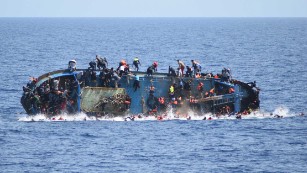


 Resenärer: länk1 länk2
 Sen är det bara att fortsätta mot Rom utan protester.


